



How Long Does It Take to Make an Animated Movie
Ever watched an animated movie and wondered how long it took to create?
What seems quick and simple on screen often takes years to bring to life.
So, how long does it take to make an animated movie?
With artists, voice actors, and directors working closely together, even small creative changes can add months to the process. To put that time into perspective, animated films typically run at 24 frames per second, which means a 90-minute movie can include over 129,000 individual frames, each one carefully crafted.
When you understand the scale of that work, the long timelines start to make sense.
This article breaks down the full animation process, from early planning and character design to rendering and final release, so you’ll see exactly why animated films take years to complete.
Key Takeaways
- Animated movies typically take 18 months to 5 years to produce, depending on style, budget, and production scale.
- The animation production process includes pre-production, animation, post-production, and distribution, each requiring specialized teams and workflows.
- 2D animation, 3D animation, stop-motion, and hybrid techniques influence both creative possibilities and production timelines.
- Thousands of individual frames must be created and refined, which is why feature-length animated films require extensive planning and coordination.
- Strong project management, technology, and collaboration help animation studios maintain quality while keeping production schedules on track.
Animation production involves many moving parts, and even small adjustments can affect the entire timeline. From script revisions to rendering challenges, several behind-the-scenes factors can extend production schedules.
The infographic below highlights some of the most common reasons animation projects take longer than expected.
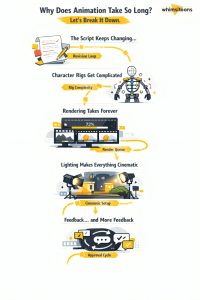
Why Making an Animated Movie Takes So Long
An animated movie takes years because every element is created from scratch, which explains why do animated movies take so long to make compared to other film formats.
Unlike live-action projects, an animated film doesn’t rely on real-world sets or actors, every movement, expression, and scene must be designed, built, and refined across a long animation production process.
1. Every Frame Is Carefully Created
A feature-length animation contains tens of thousands of frames, each requiring precise timing and consistency.
This level of detail naturally extends the animation workflow and demands careful review at every stage. Because every frame must be planned, animated, and refined, many creators ask how long does it take to animate a movie once production officially begins.
2. Stories Evolve Throughout Production
The process often begins in pre-production, where story development and storyboarding shape the narrative.
As ideas improve, scenes may be rewritten or reworked, which can ripple through animation, timing, and sequencing.
3. Character Design and Performance Take Time
From early character design to voice acting and casting, bringing animated characters to life is a layered process.
Dialogue, expressions, and movement must align perfectly, often requiring multiple revisions.
4. Large Teams Must Work in Sync
An animation studio coordinates artists, directors, and technical teams across different phases of production.
When one part of the animation workflow changes, adjustments are often needed elsewhere, adding time.
5. Post-Production Is Just as Demanding
After animation comes post-production, where visual effects (VFX), sound, and final edits are applied.
These steps refine the film and prepare it for distribution and release, ensuring it meets creative and audience expectations.
Roles vs. Responsibilities in an Animation Team
| Role | Core Responsibility | Collaboration With | Key Deliverable | Phase |
| Director | Vision and pacing | All teams | Story flow | All stages |
| Storyboard Artist | Visual plan | Writer, director | Storyboards | Pre-production |
| Animator | Movement & performance | Rigging, modeling | Animated shots | Production |
| Sound Designer | Audio sync & tone | Editor, composer | Sound mix | Post-production |
| Producer | Budget & scheduling | Entire team | Project delivery | All stages |
The Role of Voice Acting & Casting in Animated Films
Voice acting and casting play a huge role in how audiences connect with animated characters. A character can look perfect on screen, but without the right voice, it won’t feel real.
That’s why casting decisions often begin early, alongside story planning and initial character concepts.
How Are Voice Actors Selected?
Voice actors are usually chosen through auditions, with teams focusing on how well a voice matches a character’s personality and emotional range.
During this stage, creative teams often:
- Test voices against early visual sketches or rough scene layouts
- Check emotional timing and delivery
- Make sure the voice feels natural within the overall production process
Tip:
| Many studios record temporary or “scratch” voices early on to test pacing and tone before final casting decisions are made. |
Why Is Voice Acting So Important?
Voice performances give characters emotion, rhythm, and personality.
A strong performance can influence several creative elements, including:
- The overall mood and atmosphere of a scene
- How music supports emotional moments
- Timing of reactions and expressions
When voice acting is done well, it strengthens scenes long before the final stages of production.
Note:
| In many projects, voice recordings directly guide how expressions, gestures, and timing are planned. |
How Long Does Voice Acting Take?
Voice recording can take anywhere from a few weeks to several months, depending on the scale and complexity of the project. Larger productions often require:
- Multiple recording sessions
- Re-recordings as scenes evolve
- Adjustments to match story or visual changes
All of this adds time, but it helps ensure performances feel natural, consistent, and polished in the final film.
What Are The Techniques Used in Animation
-
Hand-Drawn Animation
This traditional approach involves creating images frame by frame by hand.
While time-intensive, it allows for expressive visuals and a distinctive artistic style.
Many brands and storytellers still rely on professional 2D animation services to achieve this handcrafted look while maintaining production efficiency.
-
3D Animation
Modern animation often relies on 3D computer-generated frames to build depth, realistic movement, and detailed environments.
This technique is widely used for its flexibility and visual consistency.
-
Stop-Motion Animation
With stop-motion animation, physical models or puppets are photographed one frame at a time, creating a handcrafted and tactile visual experience.
-
Motion-Capture Animation
Motion-capture records real human movement and applies it to digital characters, resulting in more natural motion and fluid performance.
-
Hybrid Animation Techniques
Many studios blend multiple methods to support creativity and efficiency.
By combining traditional and digital approaches, teams can choose the best technique for each scene.
Together, these techniques support a smooth workflow, helping productions maintain quality while staying on schedule.
How Much Time Is Allocated to the Animation Process?
The main animation phase can last from several months to a few years.
The complexity of visuals, movement, and detail determines the total animation production timeline. Many studios streamline this stage by working with teams that specialize in professional 3D animation services, ensuring that modeling, rigging, and rendering are handled efficiently.
Working with professional 3D animation services or whiteboard animation video services often shortens production without compromising quality.
Real-World Case Study:
| Pixar Animation Studios’ 1995 film Toy Story marked the first full-length CGI animated feature and required an estimated 800,000 machine-hours of rendering time, showcasing how pioneering animation procedure and heavy compute loads directly impacted production timelines. |
-
Special Effects and Visual Enhancements
Visual enhancements play a major role in shaping the final look of an animated project.
Practical elements may be captured during hybrid productions, while digital enhancements are added later to refine lighting, textures, and movement.
These enhancements often extend schedules due to simulation complexity and processing demands.
To manage this, animation teams rely on professional software tools that help balance quality with efficiency.
-
Final Editing and Audio Finishing
Once visuals are locked, the project moves into final editing and audio work.
This stage includes refining pacing, balancing visuals, and aligning sound elements with on-screen action.
Composers and editors collaborate closely to ensure scenes feel emotionally complete and rhythmically consistent.
Depending on the project’s scale, this phase alone can take several months.
-
Music and Emotional Tone
Music plays a powerful role in guiding audience emotion.
Composers study scenes, visual timing, and narrative beats to create themes that enhance storytelling.
Whether original compositions or licensed tracks are used, careful integration ensures the music supports, not distracts from, the story unfolding on screen.
-
Quality Control and Testing
Before release, extensive testing ensures the project meets creative and technical standards.
This includes reviewing lighting consistency, visual clarity, and synchronization between sound and motion.
Feedback from test screenings often leads to revisions, which is another reason people ask do animated movies take longer to make than expected.
-
Preparing for Release
Once final approvals are complete, the project moves into launch preparation.
This includes marketing coordination, scheduling, and global rollout planning.
Delays earlier in production can influence release timing, making careful planning essential during the final stretch.
Advanced Technology and Workflow Optimization
In modern animation production, technology defines efficiency and innovation.
Studios use advanced workflow management systems to coordinate teams across sketching, modeling, rigging, and post-production.
Real-World Case Study:
| DreamWorks Animation architects built a disciplined digital infrastructure over decades to support high-volume CGI feature production, demonstrating how robust pipeline planning and tech investment can streamline complex workflows. |
Conclusion
So, how long does it take to make an animated movie?
The honest answer is, it depends on how well every stage fits together.
Early planning sets the foundation, creative decisions shape the pace, and execution determines whether timelines stay on track or stretch further.
A well-structured workflow keeps production moving, but larger projects, complex visuals, and revisions can still add years to the process.
The final stretch, preparing the film for release, adds its own layer of timing before audiences ever see the result.
In the end, it’s not just about speed. The time an animated movie takes is a reflection of the care, coordination, and craftsmanship behind every frame.
Have an idea for an animated story or video?
Let Whimsitoons turn your concept into compelling visuals.
Reach out at info@whimsitoons.com or call (646) 536-8048 to start the conversation.
FAQs
1. What makes Whimsitoons different from other animation studios?
Whimsitoons focuses on combining storytelling and design precision, offering end-to-end animation services that streamline production without compromising creativity or quality.
2. How does Whimsitoons ensure the timely delivery of animated projects?
With an optimized animation workflow and dedicated project management, Whimsitoons maintains clear timelines, ensuring each phase, from animatics to post-production, stays on schedule.
3. How long does it take to make an animated movie in the USA?
A full-length animated movie in the USA typically takes 18 months to 5 years, depending on budget, complexity, and production scale.
4. What is the typical production time for a 3D animated feature film?
A 3D animated feature film generally requires 3 to 5 years, given its detailed modeling, rendering, and visual effects work.
5. How long does 2D and 3D feature animation take?
2D animation usually finishes within 1 to 2 years, while 3D animation can extend to 3 to 5 years, due to higher technical demands.
6. What is the average timeline for producing an animated film in the US?
The average timeline for producing an animated film in the US ranges between 2 and 4 years, influenced by project size, animation style, and available resources.
7. How long does it typically take to make a full-length animated movie?
On average, a full-length animation takes between 18 months and 5 years, depending on the animation workflow and complexity.